Read the scene
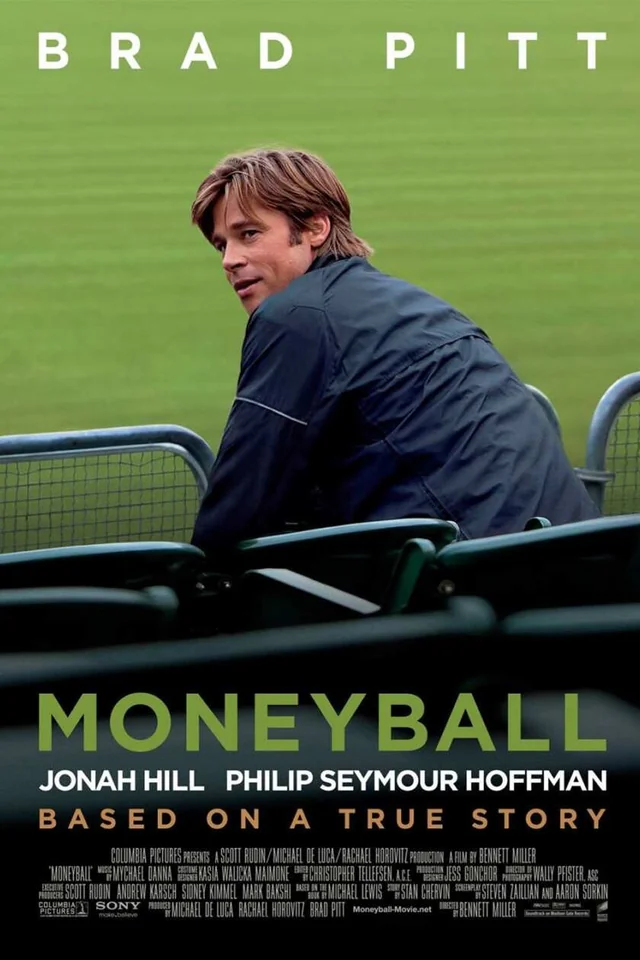
Billy and Peter’s first conversation. Screenplay by Steven Zaillian and Aaron Sorkin.
INT. INDIANS CORPORATE OFFICES - DAY
Peter sits at his cubicle absorbed in his computer until he notices Billy hovering over him.
BILLY
Hey.
PETER
Hi.
BILLY
Who are you?
PETER
My name is Peter Brand.
BILLY
What do you do?
PETER
I’m special assistant to Mark Shapiro.
BILLY
So what do you do?
(pointing at co-worker)
Hey, mind your own business.
(he does)
What do you do?
PETER
Mostly player evaluation right now.
BILLY
Why does Mark listen to you?
PETER
Actually he rarely does.
BILLY
He just did.
PETER
I don’t think he was really listening to me in there per se.
BILLY
Really?
PETER
Yeah, I think he was listening to Bruce.
BILLY
Who are you?
PETER
Peter Brand.
BILLY
I don’t give a rat’s ass about your name.
Nothing from Peter.
BILLY
What happened in there?
PETER
I’m not sure what you’re asking me.
BILLY
What did you tell Butch?
PETER
Huh? Oh Bruce? I told him I like Garcia.
BILLY
(beat)
Why?
PETER
(beat)
Probably for the same reasons you do.
BILLY
Meaning what?
PETER
He’s undervalued. You were smart to go after him.
BILLY
(long beat)
What makes him undervalued?
Peter is stuck. He can’t bring himself to say anything. After a long beat Billy nods to him in a way that seems to say, ‘I understand, it’s okay’.
BILLY
Come on.
Billy makes a strong gesture indicating Peter to follow. Which he does. They exit the offices into
INT. A VAST PARKING STRUCTURE - CONTINUOUS
BILLY
Where you from Peter?
PETER
Maryland.
BILLY
Where did you go to school?
PETER
Yale.
BILLY
I hate Yale.
PETER
Why?
BILLY
Kid from Yale once blocked a trade I was trying to make. What’d you study?
PETER
Economics.
BILLY
What are you doing in baseball?
PETER
I love baseball.
BILLY
I’m just curious. Why were you so cagey in there?
PETER
I work for a different team.
BILLY
I know, but I’m the first person in baseball who’s ever talked to you this long. Right? Why is Garcia undervalued?
PETER
Okay, truthfully, it might not be so easy to explain.
BILLY
Really? Why’s that Peter?
PETER
We might not see the game the same way.
BILLY
Oh really? What do you mean by that?
PETER
You’ve spent your life in baseball and I don’t have a very traditional view of the game.
BILLY
Hey Pete, just say it. I’m not about to beat you up. Say what you’ve always wanted to say to a GM.
PETER
Baseball thinking is medieval. It’s stuck in the Dark Ages. I have a more scientific view of the game.
BILLY
Keep going, Peter.
PETER
There is an epidemic failure within the game to understand what’s really happening. And it leads people who run major league teams to misjudge their players and mismanage their teams. They’re still asking the wrong questions. People who run baseball teams still think in terms of buying players. Sorry to say that.
BILLY
Peter, don’t apologize for what you believe.
PETER
The goal shouldn’t be to buy players, what you want to buy is wins. To buy wins, you buy runs. You’re trying to replace Johnny Damon. The Red Sox look at Johnny Damon and they see a star worth seven point five million a year. When I look at Johnny Damon, I see an imperfect understanding of where runs come from.
SUDDEN CUT TO:
ARCHIVAL VIDEO: The back of Johnny Damon’s A’s jersey as he walks to the plate to adoring Oakland fans.
PETER V/O
His batting average is ignorable. What matters is his on base percentage-
DAMON swings at the first pitch and knocks it into left field for a single. He leads off first--
PETER V/O
- which in 2001 was .324. That’s 10 points lower than league average, and 17 points lower than Garcia’s.
On the next pitch, DAMON takes off for second--
PETER V/O
True, he stole some bases. But attempted steals in general have to succeed 70% of the time before they even start to contribute to run totals. In 2001 he cost you runs.
DAMON’s tagged out at second.
BACK TO THE GARAGE
PETER
He’s got a good glove. He’s a decent leadoff hitter. He steals bases. But he’s not worth the seven point five million Boston is paying him. You’re lucky to have him off your payroll, it opens all kinds of interesting possibilities.
BILLY
You read Bill James, Pete?
PETER
Yes. These ideas and this approach to the game aren’t all new. In fact, some of them have been around for two decades.
BILLY
If this approach has been around for so long, why isn’t anybody in baseball doing them?
PETER
That’s a much more difficult question than how to win baseball games. Once you begin to pull at that string, your understanding of the world might begin to unravel.
The elevator door closes.
An unanswered question follows Billy out of the room
Billy has just failed to secure a trade. During the meeting, he notices Peter quietly influencing the people making the decision. Afterwards, he finds Peter at his cubicle and asks who he is and what he does. The office exchange begins on PDF page 32, printed page 30.
Billy has a practical puzzle: why does this apparently junior employee have a say? Peter is at work when a visiting general manager starts questioning him. Later, Peter explicitly points out that he works for a different team. His caution has a professional basis. It need not be played as a general fear of powerful people.
Give them jobs that pull against each other
For Billy, try getting Peter to reveal the thinking that stopped the trade. His obstacle is a man who answers narrowly and redirects credit towards someone else. Repeating the question is one available tactic; it cannot do all the work.
For Peter, try getting through the encounter without giving away more than you should. That objective can sit alongside a competing desire to have your ideas understood. The scene gives you opportunities to test both: he evades, offers a small assessment, hesitates, then explains at length.
These are rehearsal proposals. A different Peter might be checking whether Billy deserves a serious answer. A different Billy might already suspect he has found someone useful. Choose one version for a run and see what the other actor makes you reconsider.
Billy: change what the question is trying to do
On printed page 31, Billy asks Peter’s identity again after already hearing his name. The words have failed to get the kind of answer he wants. Play the dissatisfaction with that answer, rather than simply repeating the first delivery more loudly.
Peter’s evasions can make you narrow the question, challenge an explanation or ask for an example. His comment that Garcia is undervalued gives Billy something specific to pursue. At that point, can curiosity start to compete with irritation?
Try keeping the volume steady for one rehearsal. Find another way to pursue the answer when force stops helping: a more precise question, a pause long enough to be answered, or a direct invitation. This is a constraint for exploration, not a rule about how Billy should sound.
Peter: decide how much each answer costs
Peter first supplies his name and job title, then downplays his influence. On printed page 31, he also corrects Billy’s mistaken name for Bruce. That small correction gives you something active to do inside the pressure. Peter is capable of attending to detail and answering precisely.
When he calls Garcia undervalued, he follows it with approval of Billy’s interest. Try that as an attempt to make a limited answer sufficient. If Billy accepts the compliment, perhaps the conversation can end without the reasoning being exposed.
It does not end. On printed page 32, the direction explicitly describes Peter unable to bring himself to speak. Let the difficulty come from a decision with consequences. Compare protecting your employer with protecting an idea from being dismissed. Notice how differently you listen for permission to continue.
The pause changes the route to an answer
The script gives Billy a long beat, then a nod which seems to acknowledge Peter’s difficulty. He gestures for Peter to follow, and they leave the offices. In the parking structure he asks about Peter’s background before returning to the baseball question.
The change of location does not instantly remove the obstacle. Peter still mentions working for another team and suggests that their views of the game may differ. Billy has to invite a less guarded answer and then encourage him to keep going.
A useful interpretation is that Billy begins making it possible for Peter to say what he knows. Test the alternative too: Billy might use informality to get information more efficiently. The same written actions can carry either approach. Ask your partner which behaviour actually made continuing easier, rather than deciding that a nod must communicate kindness.
The explanation still needs someone to persuade
Peter becomes outspoken about failures in baseball thinking, then apologises. Billy tells him to stand by his belief. That exchange on printed page 33 gives both actors a fresh task: Peter checks whether he has gone too far, while Billy keeps the argument coming.
For Peter, make the explanation answer the person in front of you. Billy has a specific problem involving players and money. Let that problem organise your examples. Expertise can be an attempt to help, convince or win respect; choose a playable action instead of demonstrating that you are clever.
For Billy, follow the claims closely enough to ask the next question. By printed page 35, he is asking why an established approach has not been adopted. The subject has widened from one failed trade to how people understand the game. Do not decide in advance on the expression that will announce a conversion.
Printed page 34 cuts to archival video with Peter’s voice over it, then returns to the garage. In a rehearsal room, mark that transition clearly. Treat the speech as written material with an intended listener, rather than inventing face-to-face reactions for a passage the screenplay presents differently.
Rehearse the point where an answer becomes possible
Work with a partner for about twenty minutes, using the office exchange through the first sustained explanation in the garage. Keep the circumstances fictional. Agree the space and movement; pressure can come from the questions without physical contact or blocking someone’s exit.
- First pass: Billy tries to extract the reasoning behind the decision. Peter tries to protect his professional position. Keep the written words and pauses. Afterwards, each actor names the answer or action that made their task harder.
- Second pass: Billy tries to make it possible for Peter to explain. Peter tries to find out whether his reasoning will get a fair hearing. Keep the text and compare the change in attention. Do not agree beforehand where Peter should become comfortable.
- Third pass: return to your preferred objectives. Mark one moment when a tactic fails and another when the partner offers something new. Play through both without recreating a successful delivery. Identify the cue you actually responded to.
Prepare the argument without fixing every response
Before rehearsing, mark what each answer reveals and what it leaves unanswered. Our guide to marking up a script can help you keep those notes practical. For Peter, understand the progression of his argument. For Billy, know what information each question seeks.
In Action, import an authorised PDF, check the detected roles and scenes, then choose your character while the app reads the other parts. Use solo practice to get secure with the wording and cues. Return to a human partner to explore how hesitation, resistance and encouragement change the exchange.
Work from this copy’s circumstances
This study follows an undated screenplay copy credited to Steven Zaillian and Aaron Sorkin, with a story credit for Stan Chervin, based on the book by Michael Lewis. The selected exchange occupies PDF pages 32 to 37, printed pages 30 to 35. The copy includes print-production markings, but no identified screenplay draft or revision date.
The observations above come from the page, including its locations, pauses and archival-video passage. The proposed objectives and tactics are acting experiments. They do not describe the released film’s exact dialogue or staging, or claim to know how its performers prepared.
Rehearse your next scene
Bring a script you are authorised to use, choose your role and run the lines aloud with Action reading the other parts.
Download Action on the App Store