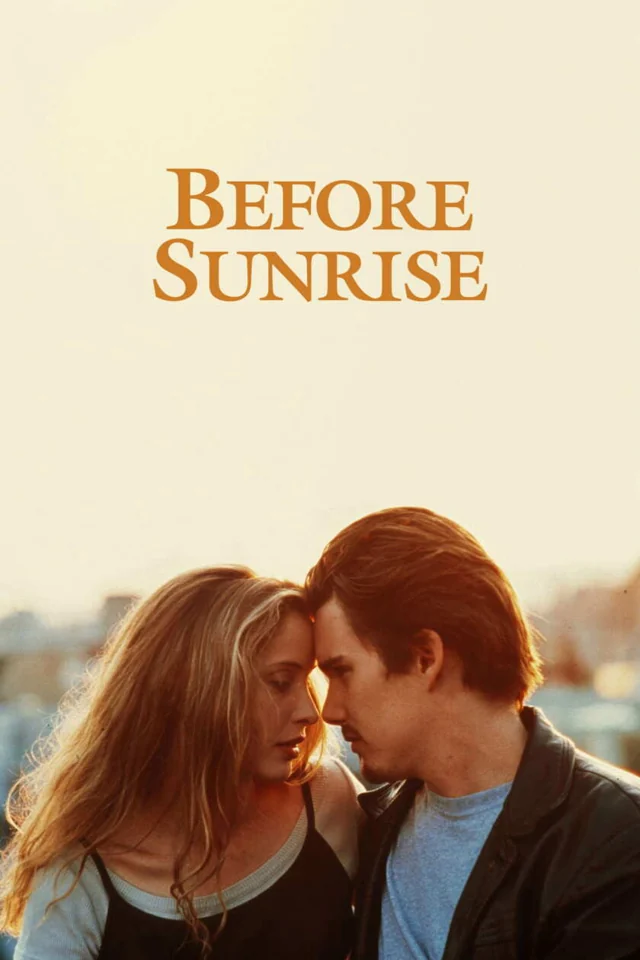
Read the scene
Jesse and Celine in the record store. Screenplay by Richard Linklater and Kim Krizan.
INT. RECORD STORE - DAY
They enter the old, vinyl-only store and start to browse.
JESSE
Is that a listening booth over there?
CELINE
Yes, I think so.
They keep looking through albums. She eventually finds an album and holds it up to him.
CELINE (CONT’D)
Have you ever heard of this singer?
JESSE
(reading)
No.
CELINE
I think she’s American. I have this friend in LA who told me about her. I’ve never been able to find any of her stuff. I think it’s kind of folksy, lyrical stuff.
Jesse points across the store.
JESSE
Lets’ see if that listening booth works.
CELINE
Let’s try it.
They walk over to the booth and enter. She takes the album out and puts it on the turntable. As the music starts they both kind of lean against opposite walls in the small glass booth and concentrate on the song.
SONG
There’s a wind that blows in from the north
And it says that loving takes its course
Come here, come here
No, I’m not impossible to touch
I have never wanted you so much
Come here. Come here...
They glance subtly up at each other but usually not when the other is looking. The song makes both of them a little nervous as it brings out a shyness about the uncertainty of their relationship at that point.
The shared task gives them somewhere to look
The record-store scene begins on PDF page 26, printed page 25. Celine finds an album and shows it to Jesse. On the next page they enter a listening booth, start the record and lean against opposite walls. The script describes shy glances that mostly miss each other.
That is enough to give both actors something concrete to work with. You can listen, find a comfortable place to stand and decide whether to look across. Try those actions before adding a general instruction to look attracted or awkward.
Give each person a different question
For Celine, try sharing something that matters to you and finding out whether he likes it. For Jesse, try finding out whether your company is welcome. These are proposed rehearsal choices, not claims about the writers’ intentions or the actors’ preparation.
Attach the question to something you can notice. A partner settling into the activity might reassure you; a brief glance might make you more uncertain. Avoid deciding beforehand that every look means the same thing. Give yourself a reason to keep checking.
Playing Celine: keep the music worth hearing
Celine has chosen the album. Try treating the listening as a genuine discovery, with something to attend to besides Jesse. You do not need to keep signalling that you know he is there. Let the shared experience compete with your curiosity about him.
On another pass, make sharing your taste feel like a small risk. Notice whether you start checking for approval, explaining yourself with a smile or retreating into the task. Keep only the behaviour that arises from the attempt, rather than deciding on a charming expression in advance.
Playing Jesse: allow yourself to be affected
Give your partner time to introduce the activity. Trying to make the encounter successful does not require you to supply an answer every few seconds. You can stay involved by taking in what she has chosen and noticing whether she seems comfortable sharing it.
Test a different objective on the next run: make it easy for her to enjoy the moment. Compare that with trying to discover whether she likes you. Both can produce stillness, but they put your attention in different places. Ask your partner what changed, without asking whether you looked sufficiently romantic.
Let noticing change the task
The stage directions on PDF page 27, printed page 26, make uncertainty part of the encounter. A useful rehearsal question is what changes when you suspect that the other person has noticed you looking.
Your immediate job may shift from finding reassurance to keeping a private thought private. Or a look may make it easier to stay present. Let the particular response prompt the adjustment. A fixed sequence of look, smile and look away can become a routine that survives even when your partner behaves differently.
If a production sets precise eyelines or blocking, keep those agreed positions. You can still investigate why you look at the required moment and what you take from the person you see.
Do less decoration, keep more attention
A quiet scene can make actors feel responsible for filling the frame. Try removing one habit from a rehearsal: a repeated smile, a foot shuffle or a movement you use whenever you feel watched. Keep the objective and see what is left.
The aim is not a blank face. Attention may alter breathing, posture or timing without a deliberate effort to display it. Watch a rehearsal back once with the sound low and ask whether you can follow a changing interest. Use the recording to notice patterns, then return your attention to the partner.
A silent shared-task exercise
Work with a partner for about fifteen minutes. Choose an ordinary shared activity, such as looking at two photographs or listening to a short piece of music you can use for practice. Agree a comfortable distance and keep the exercise free of physical contact.
- First pass: spend a short time with the activity. Give each actor a private question, such as whether the other person wants to stay. Do not plan when to look. Afterwards, name one concrete thing you noticed, rather than guessing your partner’s feelings.
- Second pass: keep the activity, but change one objective. One actor might try to share a discovery while the other tries to make them comfortable. Let the task remain interesting in its own right. Compare where your attention went.
- Third pass: return to the written scene and its actual staging. Carry one discovery into the run without recreating a successful glance. Afterwards, identify a moment when something your partner did changed your next action.
Prepare the lead-in, then return to a partner
On your own, read what happens immediately before the quiet passage. Mark the practical activity, the relationship facts and a question you want to test. You can also rehearse handling a prop so that an unfamiliar object does not consume all your attention later.
Action can help you practise the spoken lead-in from an authorised script: import the PDF, check the scenes and roles, then choose your character while the app reads the other parts. Explore the silent exchange with a human partner, where a look can produce an unexpected response.
Use the page as a starting point
This study follows an undated screenplay copy credited to Richard Linklater and Kim Krizan. Scene 13 occupies PDF pages 26 to 27, printed pages 25 to 26. The title page gives no draft date or revision label.
The rehearsal choices here are experiments. They are not an account of the released film’s exact timing or the performers’ working methods. After reading the scene, watching a performance can give you another observation to test, without making its rhythm the only possible one.
Rehearse your next scene
Bring a script you are authorised to use, choose your role and run the lines aloud with Action reading the other parts.
Download Action on the App Store