Read the scene
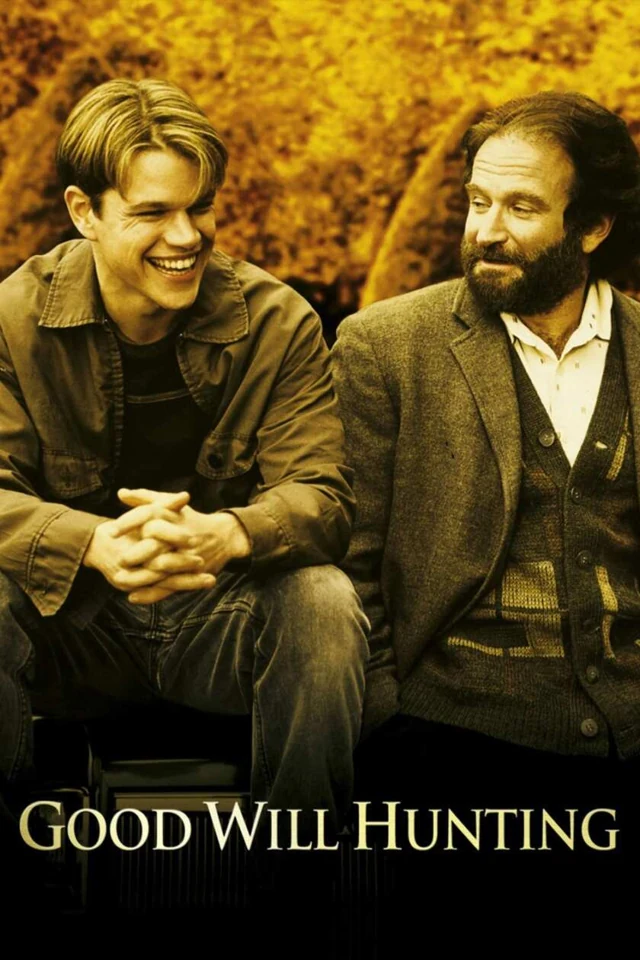
Sean and Will at Boston Common. Screenplay by Matt Damon and Ben Affleck.
EXT. BOSTON COMMON -- MINUTES LATER
Sean and Will sit in the bleachers at the mostly empty park. They look out over a small pond, in which a group of schoolchildren on a field trip ride the famous Swan Boats.
WILL
So what's with this place? You have a swan fetish? Is this something you'd like to talk about?
SEAN
I was thinking about what you said to me the other day, about my painting. I stayed up half the night thinking about it and then something occured to me and I fell into a deep peaceful sleep and haven't thought about you since. You know what occurred to me?
WILL
No.
SEAN
You're just a boy. You don't have the faintest idea what you're talking about.
WILL
Why thank you.
SEAN
You've never been out of Boston.
WILL
No.
SEAN
So if I asked you about art you could give me the skinny on every art book ever written...Michelangelo? You know a lot about him I bet. Life's work, criticisms, political aspirations. But you couldn't tell me what it smells like in the Sistine Chapel. You've never stood there and looked up at that beautiful ceiling. And if I asked you about women I'm sure you could give me a syllabus of your personal favorites, and maybe you've been laid a few times too. But you couldn't tell me how it feels to wake up next to a woman and be truly happy. If I asked you about war you could refer me to a bevy of fictional and non-fictional material, but you've never been in one. You've never held your best friend's head in your lap and watched him draw his last breath, looking to you for help. And if I asked you about love I'd get a sonnet, but you've never looked at a woman and been truly vulnerable. Known that someone could kill you with a look. That someone could rescue you from grief. That God had put an angel on Earth just for you. And you wouldn't know how it felt to be her angel. To have the love be there for her forever. Through anything, through cancer. You wouldn't know about sleeping sitting up in a hospital room for two months holding her hand and not leaving because the doctors could see in your eyes that the term "visiting hours" didn't apply to you. And you wouldn't know about real loss, because that only occurs when you lose something you love more than yourself, and you've never dared to love anything that much. I look at you and I don't see an intelligent confident man, I don't see a peer, and I don't see my equal. I see a boy. Nobody could possibly understand you, right Will? Yet you presume to know so much about me because of a painting you saw. You must know everything about me. You're an orphan, right?
Will nods quietly.
SEAN (cont'd)
Do you think I would presume to know the first thing about who you are because I read "Oliver Twist?" And I don't buy the argument that you don't want to be here, because I think you like all the attention you're getting. Personally, I don't care. There's nothing you can tell me that I can't read somewhere else. Unless we talk about your life. But you won't do that. Maybe you're afraid of what you might say.
Sean stands,
SEAN (cont'd)
It's up to you.
And walks away.
Start with the encounter
On PDF page 54, Will makes a joke about the location. Sean answers by returning to their earlier exchange about his painting. The opening offers a useful rehearsal question: can humour still control this conversation?
Choose something specific to get from your partner before you start. As Sean, try making him take you seriously. As Will, try getting him to join the joke. Neither choice requires you to decide the scene’s emotional destination in advance.
Give both actors something to pursue
For Sean, one possible larger objective is to make Will speak honestly about himself. For Will, a playable opposing objective is to keep this man at a safe distance. These are our interpretations, not instructions from the writers or claims about the original performances.
Make the objective useful by attaching it to something you can observe. If you want to be taken seriously, what would count as a response? Your partner stopping the joke, looking at you or answering without a deflection might be enough. Keep watching for that evidence.
Avoid playing an adjective for the whole scene. Being wise, wounded or defensive gives you little to do when the other actor surprises you. Trying to persuade, unsettle or disarm them gives the next line a purpose.
Find where the approach changes
The long speech on PDF page 55 moves from examples of knowledge and experience into personal loss. It then turns towards Will’s own history. On PDF page 56, Sean leaves the decision to continue with Will and walks away.
Try a fresh action at each of those turns. You might challenge, make something personal, then offer a choice. Treat that sequence as a rehearsal hypothesis. If your partner’s response makes the next tactic unnecessary, notice it rather than forcing a planned transition.
Mark the thought that prompts a change, not a compulsory pause. A breath may follow because a new idea has arrived. Counting a set number of seconds can make the pause detached from the person you are speaking to.
Playing Sean: make the speech an attempt
A familiar speech can tempt you to deliver the version you already admire. Read this draft aloud before watching a clip, then describe what you are trying to change in the listener. Use that as your starting point for the next run.
Test two approaches. In one, try to puncture your partner’s certainty. In another, try to make it possible for them to trust you. Keep the words accurate. Compare which thoughts become urgent under each approach, and where you start pushing for an effect.
The material touches on grief. You can work through the character’s circumstances and your attention to the other actor without drawing on your own bereavement. Agree the scope of the exercise with your partner and stop if either of you needs to.
Playing Will: keep working without speaking
The draft gives Will a quiet nod near the end of PDF page 55. It leaves considerable room for the listening actor. Filling that room with a planned series of facial expressions can make you stop hearing the speech.
Try to keep your partner talking without letting them know what you think. On the next pass, try to find an opening to dismiss their argument. You do not need to add dialogue to pursue either action. Keep the urge private and allow the actual words to affect it.
Afterwards, name one thought that made your task harder. Be precise about the information you heard. “That got to me” is less useful for the next run than knowing what challenged your position. Do not preselect a visible reaction to prove that you have listened.
A three-pass listening exercise
Work from the same authorised copy and keep a pencil nearby. Allow about fifteen minutes. A partner is helpful for this exercise; if you are working alone, use the solo adaptation below.
- First pass: read the complete encounter without stopping. Each actor writes one sentence beginning “I want you to…” and names a moment when that aim became difficult.
- Second pass: give each other a different, reasonable response. The listener might be harder to amuse or more willing to engage. The speaker must keep the text and respond to what actually happens, rather than reproduce the first reading.
- Third pass: choose one adjustment from the first two runs and play through to the departure. Keep the ending available until you reach it. Afterwards, compare one discovery each, with a specific moment to support it.
Take one question into solo rehearsal
Choose a role and rehearse the complete exchange from a copy you are authorised to use. In Action, import the PDF, check the detected roles and scenes, then select your character so the app reads the other parts. Keep your acting notes beside the script.
As Sean, test whether every new thought still has a listener. As Will, practise staying occupied by an objective during the other character’s longer turn. A digital reader can help with words and cues; return to a human partner to test the mutual adjustments.
End the session by noting one choice worth keeping and one question to explore next time. You are building your own response to the scene, rather than reproducing a performance you already know.
The screenplay and the finished film
This study follows an undated screenplay copy, rather than a transcript of the released film. Its Boston Common scene places the characters on bleachers beside a pond. The closing wording in this copy is “It’s up to you.” If your rehearsal copy differs, use its wording and page references consistently.
Read the scene before watching a performance. If you watch afterwards, separate what is written from what the actors and filmmakers contribute. A useful observation describes a choice you can investigate, without claiming to know how an actor prepared it.
Rehearse your next scene
Bring a script you are authorised to use, choose your role and run the lines aloud with Action reading the other parts.
Download Action on the App Store