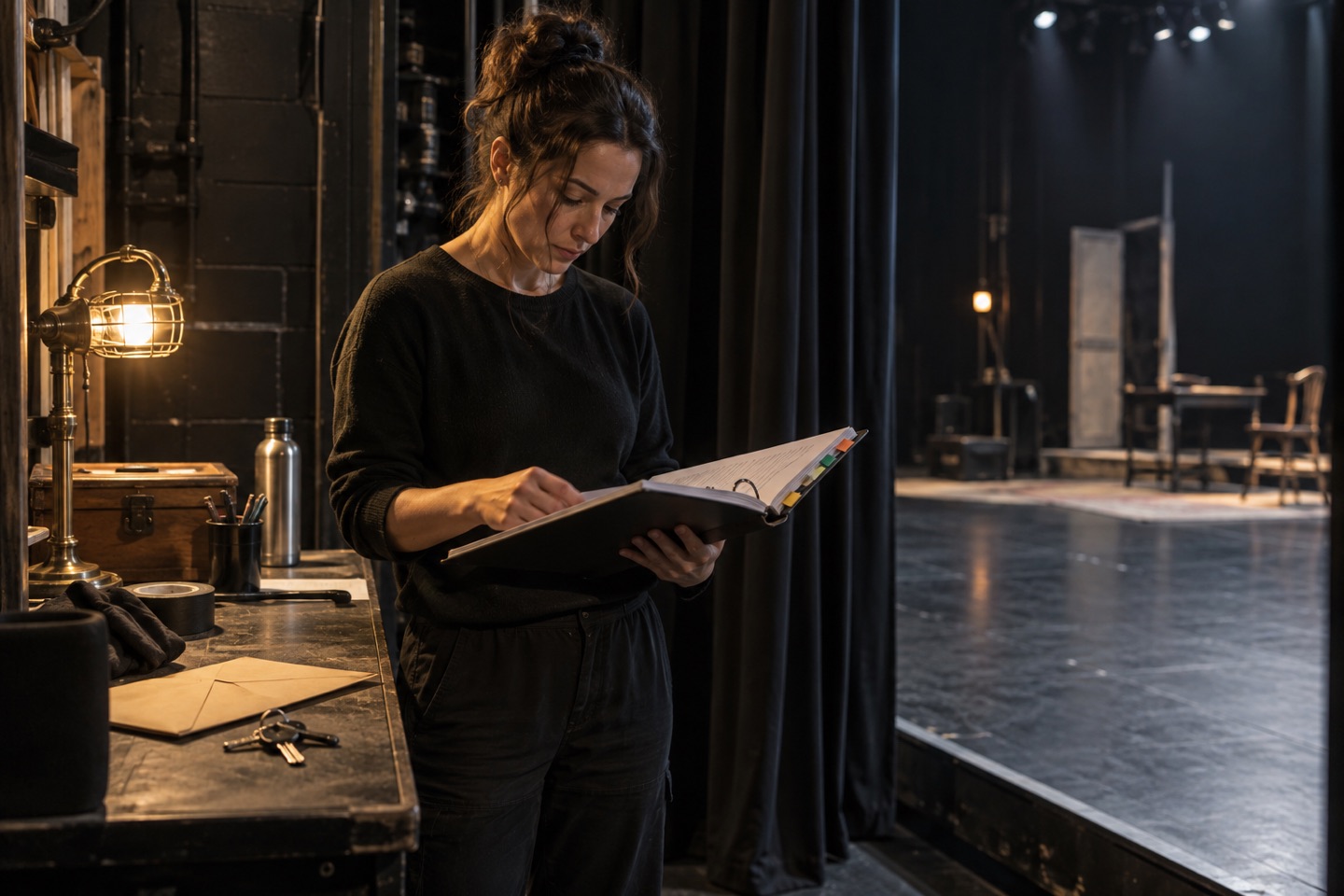
Record what happens around the lines
Note where you enter, what brings you on, what you carry, whom you interact with and where you go next. Use the production’s numbering and terminology so someone else can check your notes.
Keep the script version and dates of confirmed changes visible. Ask how updates are communicated and who should resolve conflicting instructions. An old instruction remembered confidently is still an old instruction.
Make one entry per transition
Adapt this structure to the production. Keep observation separate from confirmation: watching another performer take a route does not establish that it is your instructed route.
- Scene or cue reference and script version.
- Starting position and cue to move.
- Entrance, dialogue cue and required action.
- Prop or costume requirement and agreed handover.
- Exit and next destination.
- Unresolved question, person to check with and confirmation date.
Find the uncertainty before rehearsing it
In a fictional rehearsal, you enter with an envelope after a bell, speak two lines and leave by the opposite door. The words are easy. The uncertain parts are who supplies the envelope, which bell is the cue and where you wait afterwards.
Write those as questions rather than filling the gaps with guesses. Once confirmed, rehearse the sequence in the permitted space. Machinery, fights, intimacy work, lifts and hazardous routes need the appropriate supervised instruction. Do not reconstruct them alone from a video.
Keep different tracks separate
Give each track clearly labelled notes. Colour can help, but use written labels too. Check which track you are practising before starting. Test a transition from its own cue rather than always reciting from the top of the show.
Name the scene, establish your starting position and identify the cue. Mark anything you cannot retrieve independently for another pass. Use recordings only with permission and follow the production’s access and confidentiality rules.
Bring a short question list
Prioritise anything that prevents a safe, accurate run. An unconfirmed entrance route is more urgent than a line reading that feels unpolished. Tell the relevant team what you have not rehearsed. Private preparation cannot replace a put-in or required safety work.
After a confirmed change, check the next transition too. A new exit may affect a prop handover or the time available for a costume change. Keep a small change log so you can explain which version you are working from.
Keep working on the scene
These are suggested exercises, not fixed rules. Follow the brief, your tutor’s guidance or the production’s instructions where they differ.