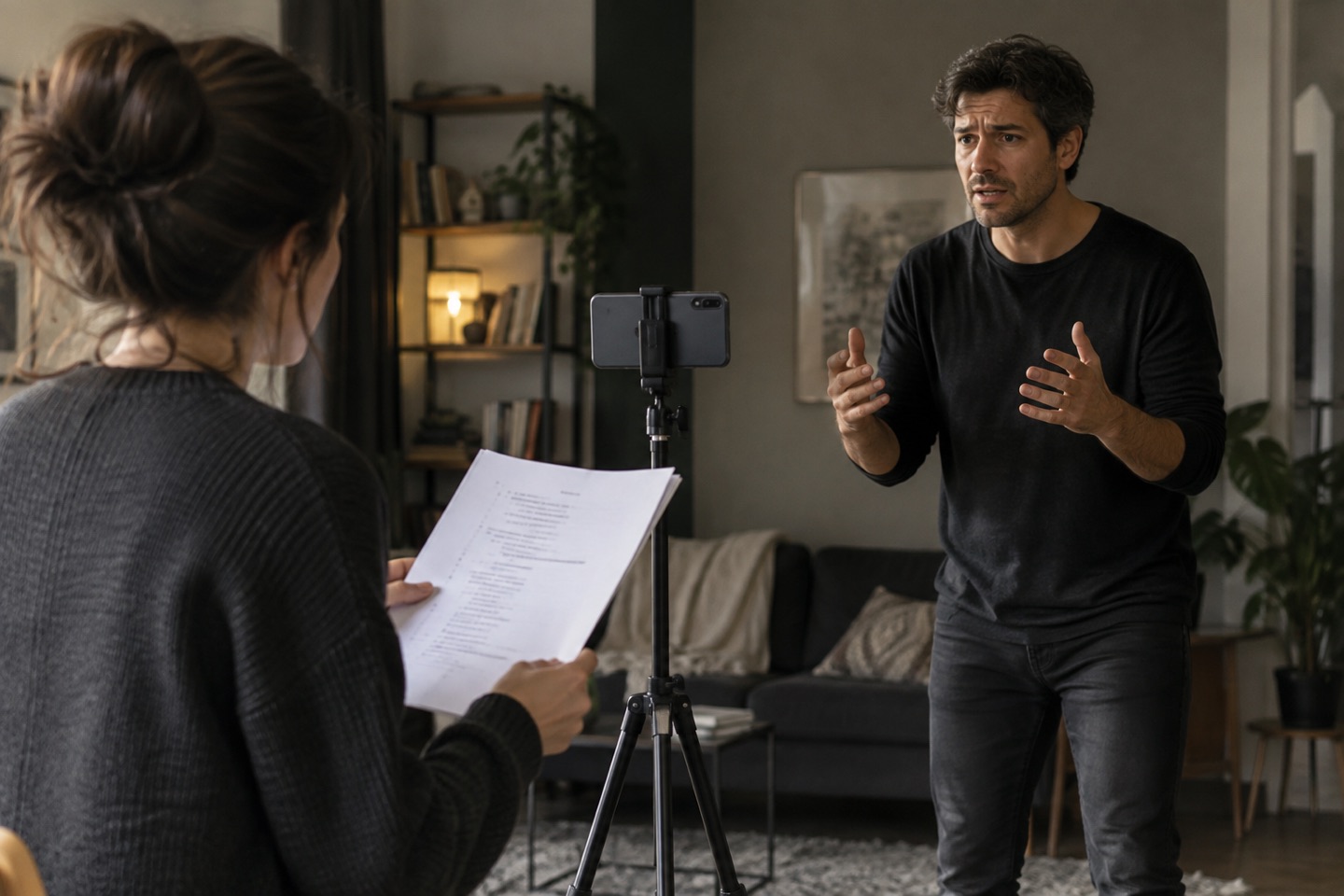
Ask what they need
Read the whole scene, not just your lines. Confirm the script version, the parts you are covering and where the take begins and ends. Ask whether the actor wants a run for sense or is ready to record.
Agree what happens if someone loses a line. You might stop, find the place and begin again. Do not feed extra prompts into a take unless you have agreed to do that. Keep the wording intact and do not read character names or stage directions as dialogue.
Check your position and volume
Sit or stand close to the camera, outside the frame, where the actor can look towards you without turning away. Hold the pages where you can read without constantly dropping your head. The actor should not have to chase your eyes.
Listen to a short test. Beside the microphone, a voice that feels quiet in the room can dominate the file. Adjust your volume or position after playback. Give the lines a thought, but avoid an elaborate accent or interpretation nobody has asked for.
Try a pause without filling it
Here is an original practice exchange. Reader: “You kept the receipt?” Actor: “I thought you might change your mind.” Reader: “About the coat?” Actor: “About coming.”
Run it once as an ordinary question about a purchase. Repeat it with the actor pausing before “About coming.” Stay available during the silence rather than signalling that the line is late. Listen to playback together: were both voices clear, and did the actor have room to finish the thought?
Ask before giving notes
“The first word was clipped” is a recording observation. “You should be angrier” is a creative intervention. Ask whether performance feedback is wanted before offering it. The actor can request another approach.
For remote reading, test the call and avoid overlap until you know what the connection can handle. If words break up, stop and fix it. Do not forward the sides, retain a recording or share the session without permission.
- Confirm the start and finish.
- Check both voices in playback.
- Keep page turns quiet.
- Agree how to reset.
- Respect the actor’s choices and the material’s confidentiality.
Keep working on the scene
These are suggested exercises, not fixed rules. Follow the brief, your tutor’s guidance or the production’s instructions where they differ.
Further reading: Spotlight: How to self-tape.