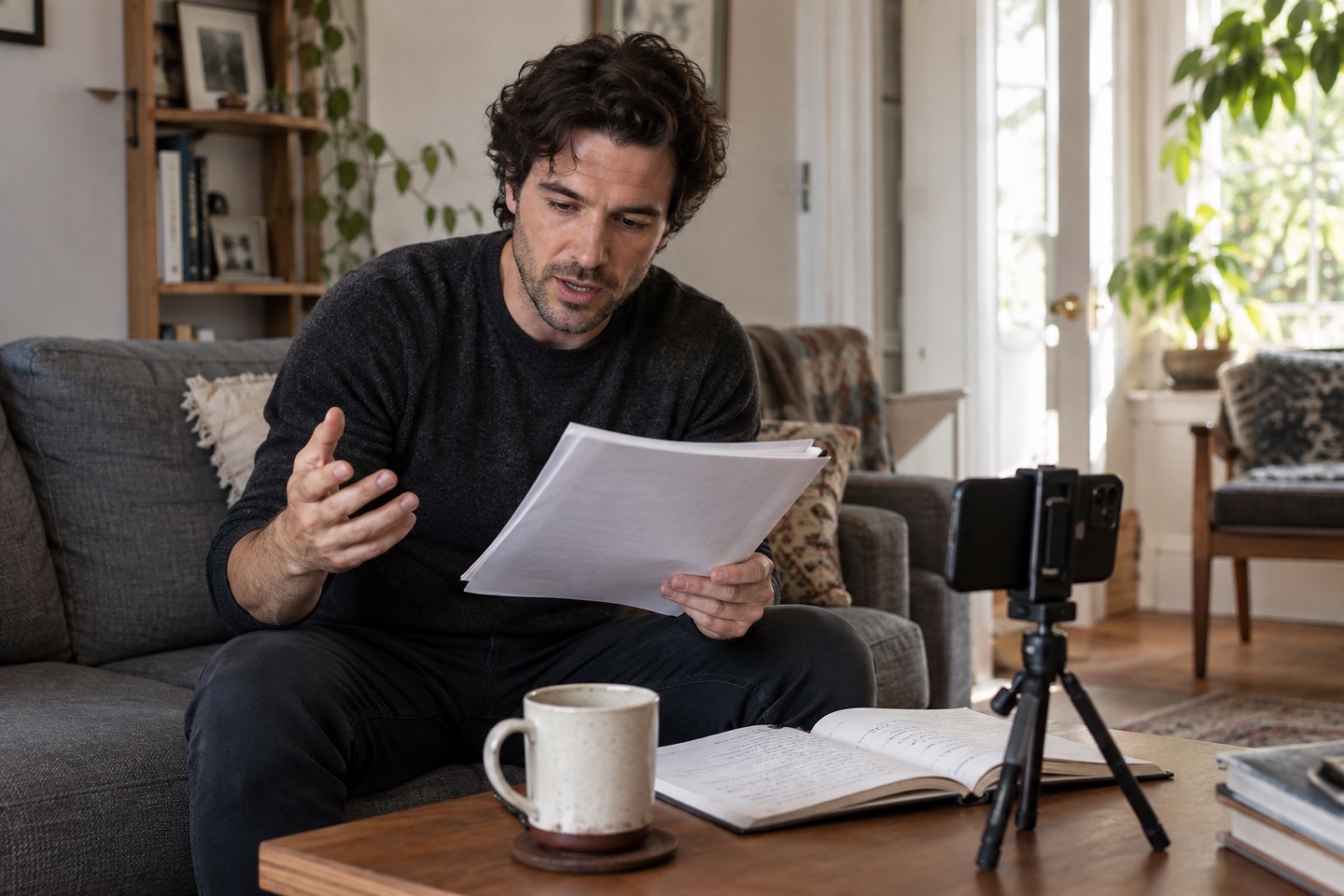
Keep less material in active use
Choose one scene and one contrasting piece you have already worked on. Use material you are permitted to practise with and respect restrictions on recording or sharing it. You do not need a growing folder of half-prepared speeches.
Keep the current text and a brief note of the circumstances, objective and last useful discovery. Date the note. This gives you a way back without requiring you to remember how a rehearsal felt weeks ago.
Try the passage before reading it again
You are finding out what is available today, not auditioning for yourself. Mark where recall fails, then check the text. Do not repeatedly guess and accidentally practise the wrong wording.
If the lines are secure, change the starting point. Can you enter midway, establish the circumstances and respond? That tells you something a familiar run from the beginning may conceal. Keep the session small enough to listen properly.
A suggested week with room for life
Use this as a menu, not a streak to protect. On a busy week, one focused check can tell you what needs attention. Classes, paid work, rest and commitments outside acting do not need to compete with an arbitrary daily target.
- First session, fifteen minutes: try the scene cold and repair two weak cues.
- Second session, twenty minutes: revisit those cues and test another supported tactic.
- Third session, fifteen minutes: record one passage and leave a note for next week.
Write a note you can act on
“That was rusty” gives you no next step. Try: “Lost the line after the question about the train. Recovered it from the full cue. Next time, start there before reading.”
For an original example, take the cue “Which train?” and the response “The one you told me not to take.” If you remember the sentence but miss its connection to the question, practise the pair. Then put it back into the exchange. Avoid drilling a tone as though it were part of the text.
Come back after a gap
Reduce the amount of material rather than trying to recover everything in one evening. Read for circumstances, test a few cues and stop with a clear next task. Replace a piece if it no longer serves your work.
Occasionally bring the scene to a class, coach or willing partner. Solo checks reveal recall and recording problems, but cannot tell you everything about working with another person. Keep feedback specific enough to test when you return.
Keep working on the scene
These are suggested exercises, not fixed rules. Follow the brief, your tutor’s guidance or the production’s instructions where they differ.